

-
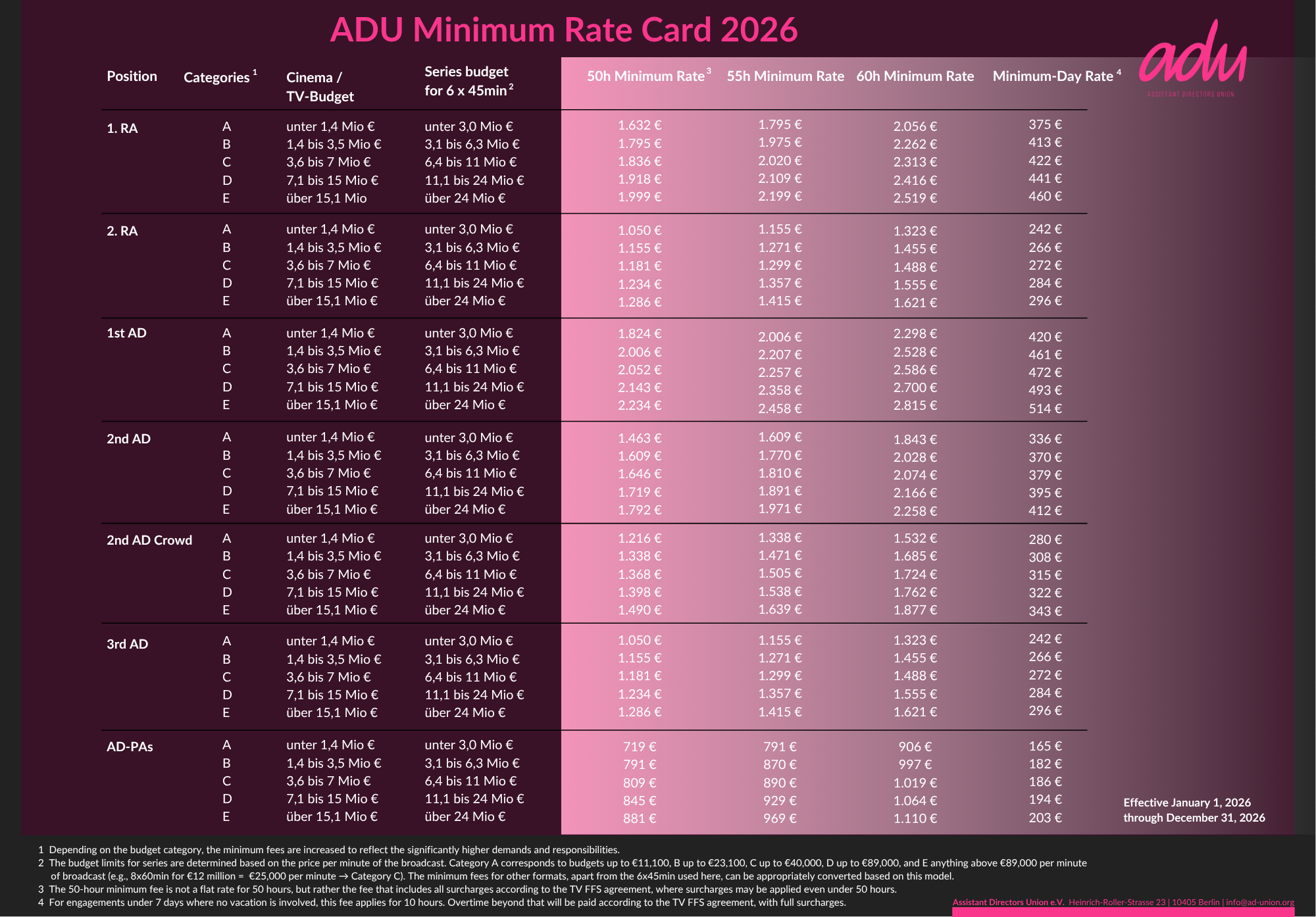
The following table is a MINIMUM FEE SCHEDULE for our members. Except in justified cases, fees should not fall below the minimum rates listed here. Such exceptions include, for example: non-commercial projects, student and debut films, or »favors for friends«. The requirement for these minimum fees is based on the job profiles defined by the ADU and reflects the high qualifications of its members.
- The structure of fee rates is based on the UK system. This means that the minimum fee is directly determined by the PROJECT TYPE and the BUDGET SIZE of the project. Particularly in the professional groups represented by the ADU, the job requirements and responsibilities for a project are closely linked to the project’s size, format and budget.
-
The minimum fees listed were derived from a comprehensive, anonymous survey conducted within the ADU, which included over 350 data points. The survey covered fees and data from 2022 to 2024. The subsequent regular fee increases under the TV FFS collective agreement were taken into account.
We consider this MINIMUM FEE REQUIREMENT to be fair for both sides: fair for our qualified members, whose working hours are compensated accordingly without fundamentally calling the fee structure into question, and fair for production companies, as we offer models with tiered partial flat rates in addition to the industry-standard 50-hour model. These continue to be based on a 5-day workweek, but allow employees to forgo the overtime premiums set by the TV FFS within their allotted hours. Overtime hours that exceed the flat-rate allowances must still be accurately recorded and compensated with all premiums in accordance with the TV FFS.
-
The ADU minimum wage table lists three weekly hour models. In addition to the regular 50-hour rates for 5-day weeks plus all surcharges according to the TV FFS collective agreement, we also offer a 55-hour and a 60-hour partial flat rate, which, however, still apply to 5-day weeks (see also point 6). These partial flat rates already include 51 or 56 to 60 working hours, as well as the overtime surcharges that would normally apply to them. The goal is to agree on a partial flat rate for more complex, labor-intensive productions, which allows a large portion of overtime to be compensated in an unbureaucratic manner. Unused hours cannot be deducted from the agreed-upon partial flat rates or offset against weeks with longer working hours. We would also like to clarify that, under the regular premium system of the TV FFS collective agreement, premiums may be payable for the 50-hour model as of January 1, 2025, even before the 50th weekly working hour is reached (see Section 5.4.3.2). Such surcharges are not included in our 50-hour rates but are payable in addition to them.
The ADU firmly rejects any further generalizations beyond the models mentioned, especially since working more than 60 hours per week is generally no longer permitted (see TV FFS, Section 5.2.5). This also applies to pre-production periods. - Every ADU member is free to negotiate higher rates based on their professional experience and/or the increased complexity of a project.
-
All other provisions of the TV FFS, as currently in effect, apply to ADU members – regardless of the negotiated fee. This includes, in particular, the provisions regarding vacation, other allowances (night shifts, the 6th and 7th working days of the week, work on Saturdays, Sundays, and public holidays), so-called reduced working hours days (AZK), as well as expenses and contributions to pension funds and/or other retirement funds. In addition, a daily fee is generally payable for each full day of work performed beyond the 5-day workweek. These amounts cannot be offset against so-called “above-scale” fees and therefore remain unaffected.
- For ADU members, only the time actually spent away from work counts as break time. Lunch breaks during which work is performed, as well as preparatory and follow-up work before and after shooting or preparation days, are recorded and billed as regular working hours.
-
The ADU is firmly opposed to reducing rest and break periods and advocates introducing shift systems in critical cases. If, in individual cases, it is nevertheless not feasible from a production standpoint to fully grant breaks and rest periods, a compensatory arrangement may be agreed upon for such working hours – but only with the employee’s consent – based on the industry-standard premium rates for shortfall in rest periods. Such consent always applies only to the specific individual case. Under no circumstances may such work be mandated.
- Film professionals regularly bring their own equipment and software of considerable value to their productions. In doing so, they relieve production companies of the obligation to provide work equipment. The ADU therefore welcomes the growing practice of establishing usage fees for personal computers, tablets, cell phone contracts, software, etc. in the industry (so-called “box rental”), and recommends addressing this issue in every contract negotiation and setting it forth in writing. The specific amount of compensation depends heavily on the individual circumstances of each case. However, it is expressly intended to cover only the wear and tear on work equipment and cannot be used to justify lower wages.
RATE
CARD

DOWNLOAD
For your reference, here is the 2025 rate card